Must-see places
Suggested itineraries
Explore Our Region: Recommended Tourist Routes to Discover and Cherish the Local Heritage.
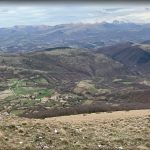
Trekking
Monte di Massa Ring
7.2 km Loop Trail near Muccia, Marche
Experience this 7.2 km loop trail near Muccia, in the Marche region. The trail is generally considered challenging and takes an average of 3 hours and 10 minutes to complete. It is suitable for hiking, mountain biking, and running, and it is unlikely to encounter many other people along the route.
Trail Description:
Start/Finish: Massaprofoglio (parking available in the square in front of Fonte di Massa).
Route: From Massaprofoglio, follow the trail clockwise to reach Monte di Massa (1305 m). Continue along the dirt road to the Torraccia and the Castello di Prefoglio. Unfortunately, both were destroyed by the last earthquake and cannot be entered.
This is a beautiful circular route that allows you to enjoy the natural landscape, historical sites, and panoramic views of the area.
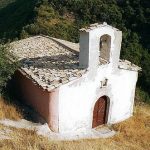
Trekking
Muccia – Prefoglio’s Madonna
This itinerary starts from the municipality of Muccia, passing through the village of Costafiore, and leads up to Monte di Costafiore, offering a panoramic viewpoint over the entire surrounding territory. The route continues to key points of interest: the Castello di Prefoglio and the Church of Prefoglio.
The fortress, dating back to the 13th century, stands along the S. Angelo Valley, shortly after the hamlet of Fiume. This valley was historically inhabited by prehistoric and protohistoric populations. Numerous archaeological finds have been recovered in the area, including a necropolis near the Rocca di Prefoglio with evidence of Eneolithic and Bronze Age settlements.
The remains of the Rocca dei Conti di Prefoglio rise to guard the pass where the valley narrows. The feudal lords who owned it were of Lombard origin and likely custodians of the Sanctuary of Sant’Angelo di Prefoglio on the opposite side of the valley. The combination of the castle’s toponym with that of the fortified farmhouse of Massa gave rise to the name Massa-Prefoglio, which later evolved into Massaprofoglio.
By Car
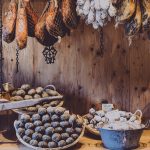
Itinerary of the Muccia Area “Norcinerias”
Before delving into the details of the itinerary, it is important to highlight that the territory of Muccia, nestled in the heart of the Marche region, is a true paradise for lovers of traditional butchery. This area, located at the foot of the Sibillini Mountains, boasts a long-standing tradition in the production of artisanal cured meats, passed down from generation to generation, offering visitors a unique gastronomic experience that combines tradition, quality, and passion.
The Marche region, and in particular the Muccia area, is renowned for the production of high-quality artisanal cured meats. Here, butchery is not only an economic activity but a true art, rooted in centuries-old traditions. The province of Macerata prides itself on many local specialties and authentic products; as locals say, in Muccia one is in the “kingdom of ciauscolo,” the iconic spreadable salami of the Marche region.
Experiences
A journey through art, history, and local traditions.
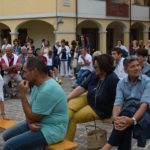
Heart of the Village, Local Delicacies
Dive into the authentic soul of this village, where tradition is passed down through generations in the form of unique flavors. Prepare for a journey of discovery dedicated to the gastronomic treasures of the area: renowned artisanal cured meats, delicious traditional sweets, naturally leavened fragrant bread, and the unmistakable Varnelli liqueurs.
Stroll through the cobblestone streets and let yourself be captivated by the rich aroma of aged salumi, crafted with time-honored techniques. Savor the expertise in every slice, a testament to a passion handed down through the ages. Don’t resist the temptation of traditional sweets, custodians of centuries-old recipes that will delight your palate with their simplicity and goodness.
Experience the pleasure of freshly baked bread, golden on the outside and soft at the heart, perfect to accompany every tasting. And finally, immerse yourself in the complex, enveloping aromas of the famous Varnelli liqueurs, a true symbol of this territory, born from a history of passion and dedication.

5 Unmissable Experiences in the Wounded Yet Tenacious Heart of the Marche
Muccia, a small village in the Marche region marked by the 2016 earthquake, today stands as a place of rebirth and authenticity. Its territory is rich in spirituality, from the Hermitage of Beato Rizzerio to rural sanctuaries and historic churches, some still awaiting restoration. The landscapes of the Sibillini Mountains, accessible via well-marked hiking trails, offer immersive experiences in nature.
On the gastronomic front, local excellence such as Varnelli liqueurs, salumi from Salumificio Bartolazzi, and artisanal pasta “Terra di Muccia” tell a story of taste and resilience. The village’s agricultural and noble past comes alive at the Mulino Da Varano and the refined Villa La Maddalena, enriched by historical ties to Bernini.
Muccia looks to the future with the new school donated by the Bocelli Foundation and the upcoming camper area, while also celebrating the beauty of nearby lakes like Fiastra and Polverina.
A visit to Muccia is more than just a trip: it is an act of solidarity, an encounter with the tenacity of a community that resists and rises again.
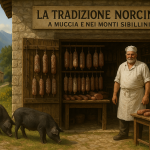
The norcineria tradition in Muccia and the Sibillini Mountains
The Butchery Tradition in Muccia and the Sibillini Mountains
Muccia, a small mountain town in the Sibillini Mountains in the province of Macerata, boasts an ancient tradition of norcineria, the art of pork processing. Throughout the Umbrian-Marchigian Apennines, pig slaughtering was an important rural ritual, and in Muccia, “from the pig comes ham, salami, ciauscolo, sausages, lonza, coppa, lard, and much more”—in other words, nothing goes to waste.
The term norcino itself refers to Norcia in Umbria, a city famous for these products, and this expertise historically spread to nearby towns in the Marche region. Muccia is part of the traditional production area for high-quality cured meats such as ciauscolo, the renowned spreadable salami from Marche recognized as a PGI (Protected Geographical Indication), covering the provinces of Macerata, Ascoli Piceno, Fermo, and part of Ancona. The practice of raising pigs and producing cured meats at home during the winter is deeply rooted in the area and passed down through generations, forming an integral part of the local food culture.